
Thomas Hardy, a Scottish-born shoemaker and dissenter, now residing in London with his wife Lydia, founded the London Corresponding Society (LCS) in 1792. Its aims were to extend democracy to working men by establishing universal (male) suffrage and annual parliaments. Gustavus Vassa, also known as Olaudah Equiano, the African, was temporarily a lodger with the Hardys while revising his autobiography which went on to be a much-read critique of slavery, even today. Vassa was also a founding member of the LCS while Lydia Hardy was active in the anti-slavery movement supporting the campaign to abstain from slave-grown sugar.
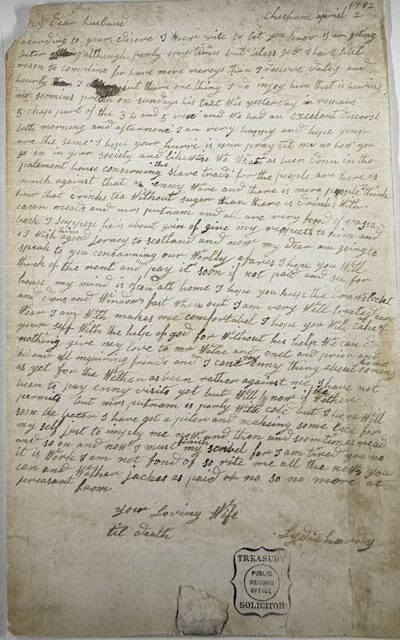
Lydia was the daughter of Nathaniel Priest, a carpenter from Chesham, Buckinghamshire. She sojourned in her home town from time to time, reporting on the success of the boycott of slave-grown sugar. Her six children died in infancy although Elizabeth survived until at least seven, George until three and Solomon was baptised in March 1794. Lydia does feature in the margins of accounts of the reform and anti-slavery movements and some letters to her husband and Gustavus Vassa survive in the National Archives. On her death a poem was written to commemorate her sad life. Her last months were certainly tragic. Over two hundred years later supporters of Fairtrade Chesham commemorated her life.
Political representation in Georgian Britain was restricted to a small group of rich men but this concentration of power was being contested during the 1790s as the revolutionary ideas from America and France had a growing influence. The publication of Thomas Paine’s The Rights of Man in 1791 inspired the establishment of many societies like the LCS which called for constitutional reform.
1793 was tumultuous. In January the French King was guillotined and France declared war on Britain. The British government used agents provocateurs and spies to infiltrate working people’s organisations and mobs were stirred to attack those who were perceived to support foreign revolutionaries or religious dissenters. At the end of the year two leading members of the LCS, including its chair, were arrested following their attendance at a convention in Edinburgh. Life for the radicals was hard. Suspicions and distrust were rife in a daily life which was infiltrated by spies and informers. In addition, the interception of letters by the authorities was common and the leaders’ reputations and characters were trashed in the press especially The Times. Penalties for those accused of agitation were harsh in a world where calls for democracy could be equated to treason. LCS members Maurice Margarot and Joseph Gerald, were found guilty of sedition as a result of their attendance at the Edinburgh convention and were transported to New South Wales the following May.
On 12 May 1794 at 6.30 in the morning Lydia was at home with her husband when he was arrested. He was subsequently committed to the Tower of London charged with high treason. She was, like other distressed LCS family members, given financial support by the society. Two weeks later a Church and King mob, celebrating the British naval victory over the French, attacked the Hardy house and shop in Piccadilly. They had suspected that she was sympathetic to the revolutionary French.Lydia had to escape through a small back window with the help of neighbours. This was only done with some difficulty due to her pregnancy and the child did not survive as a result. Despite her poor health she continued to visit her husband in the Tower where he awaited trial. Both knew that if he was found guilty the punishment was to be hanged, drawn and quartered. On 27 August Lydia, exhausted by life, died shortly after giving birth to a stillborn child.
The Crown had suspended Habeas Corpus thus enabling the accused which also included John Thelwell and John Horne Tooke to be imprisoned for some months. Usually trials for high treason were conducted over a day. Hardy had to face a 9 hour speech by the prosecution and a nine day trial but it only took the jury 3 hours to acquit him. His co-defendents were also acquitted. On November 5h he left the court feted by his supporters, but a broken man, having lost his wife, shoe shop and home. His legal fees had left him with little money.
He wrote his memoir some six years after the trial although it was not published until thirty four years later. He writes in the third person and although he explains this is to avoid using “I” repeatedly I wonder if this is to create some distance between him and the sad events of his life.
Some years ago I was at a writing workshop and we were asked to choose the name for a protagonist in a story. I chose “Lydia Hardy”. Another participant said she thought the name rather “vanilla”. I think this was a term rarely used at the time but I suspected it was used derogatorily and I now know it was! Lydia was anything but vanilla and a drama about her would be fascinating.
Bibliography
Chesham Fairtrade History https://fairtrade.org.uk/chesham-fairtrade-history
An Account of the Seizure of Citizen Thomas Hardy Secretary to the London Corresponding Society. https://www.nationalarchives.gov.uk/education/resources/why-was-radical-writer-thomas-paine-significant/why-was-radical-writer-thomas-paine-significant-source-2/
Testaments of Radicalism: Memoirs of Working Class Politicians, 1790–1885 (1977) Ed. David Vincent.

